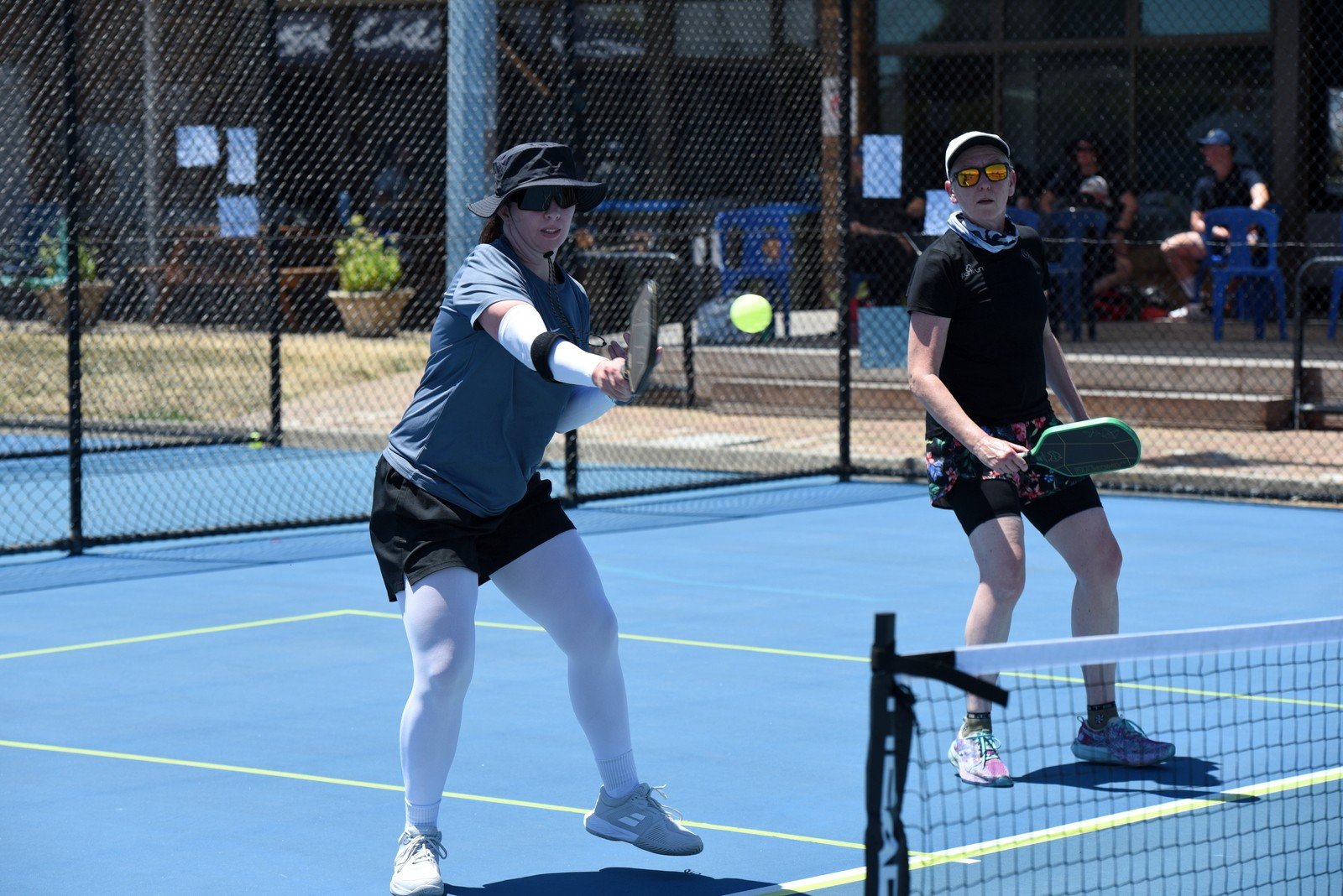
Basic Pickleball Rules

Pickleball is a fast-growing sport that combines elements of tennis, badminton, and table tennis. It’s easy to learn, fun for all ages, and can be as casual or competitive as you want it to be. Here are the basic rules every player should know when stepping onto the court.

The Court

  • Size: The court is the same dimensions as a doubles badminton court: 6.1m wide x 13.4m long (20ft x 44ft).

  • Net: The net is 86cm (34in) high in the centre and 91cm (36in) high at the sidelines.

  • Non-Volley Zone (NVZ): Commonly called the “kitchen”, this is the 2.1m (7ft) area on both sides of the net where players cannot volley the ball (hit it in the air before it bounces).

Serving

  • Start of Play: The game begins with a serve from the right-hand side of the court.

  • Underhand Motion: Serves must be hit underhand with the paddle contacting the ball below the waist.

  • Diagonal Serve: The ball must travel diagonally across the court and land in the opponent’s service box beyond the non-volley line.

  • One Attempt: Only one serve attempt is allowed, except in the case of a let (when the ball clips the net but still lands in the correct service box).

Scoring

  • Only the Serving Side Scores: Points can only be scored by the serving team.

  • Game Points: Games are typically played to 11 points, and a team must win by 2 points.

  • Tournament Variations: Some events may play to 15 or 21, still win by 2.

  • Serving Rotation in Doubles: Each player on a team serves until their side commits a fault. After both partners have served, the serve passes to the other team.

The Two-Bounce Rule

To keep rallies going and encourage longer play, pickleball has a unique two-bounce rule:

  1. The serve must bounce once before the receiver can return it.

  2. The return must also bounce once before the serving team can play it.
    After those two bounces, the ball may be volleyed (hit in the air) or played after a bounce.

The Non-Volley Zone (Kitchen)

  • Players may not volley the ball while standing in the kitchen.

  • A player may enter the kitchen to play a ball that has bounced there, but they must exit before volleying again.

  • Momentum rules apply: if you volley near the net and your momentum carries you into the kitchen (even after the ball is dead), it’s a fault.

Faults

A fault is any action that ends play because of a rule violation. Common faults include:

  • Serving into the net or out of bounds.

  • Volleying before the two-bounce rule is satisfied.

  • Volleying while standing in or touching the kitchen.

  • Hitting the ball out of bounds.

  • Letting the ball bounce twice on your side.

Singles vs Doubles

  • Singles: Each player has one serve turn per side-out, and scoring/serving rules are simpler.

  • Doubles: More common format; each partner gets a serve opportunity before a side-out. Doubles strategy adds fun teamwork and communication to the game.

Spirit of the Game

Pickleball is competitive but also highly social. Good sportsmanship is part of the culture:

  • Call lines fairly (when in doubt, give your opponent the benefit).

  • Respect the pace of play.

  • Encourage new players and enjoy the community vibe that makes pickleball unique.

👉 With these basics in mind, you’ll be ready to hit the courts and join the fun. Pickleball is easy to learn but offers endless depth as your skills grow so grab a paddle and get playing!